T. Wayne Williams Represents Tennessee as a National FFA Officer
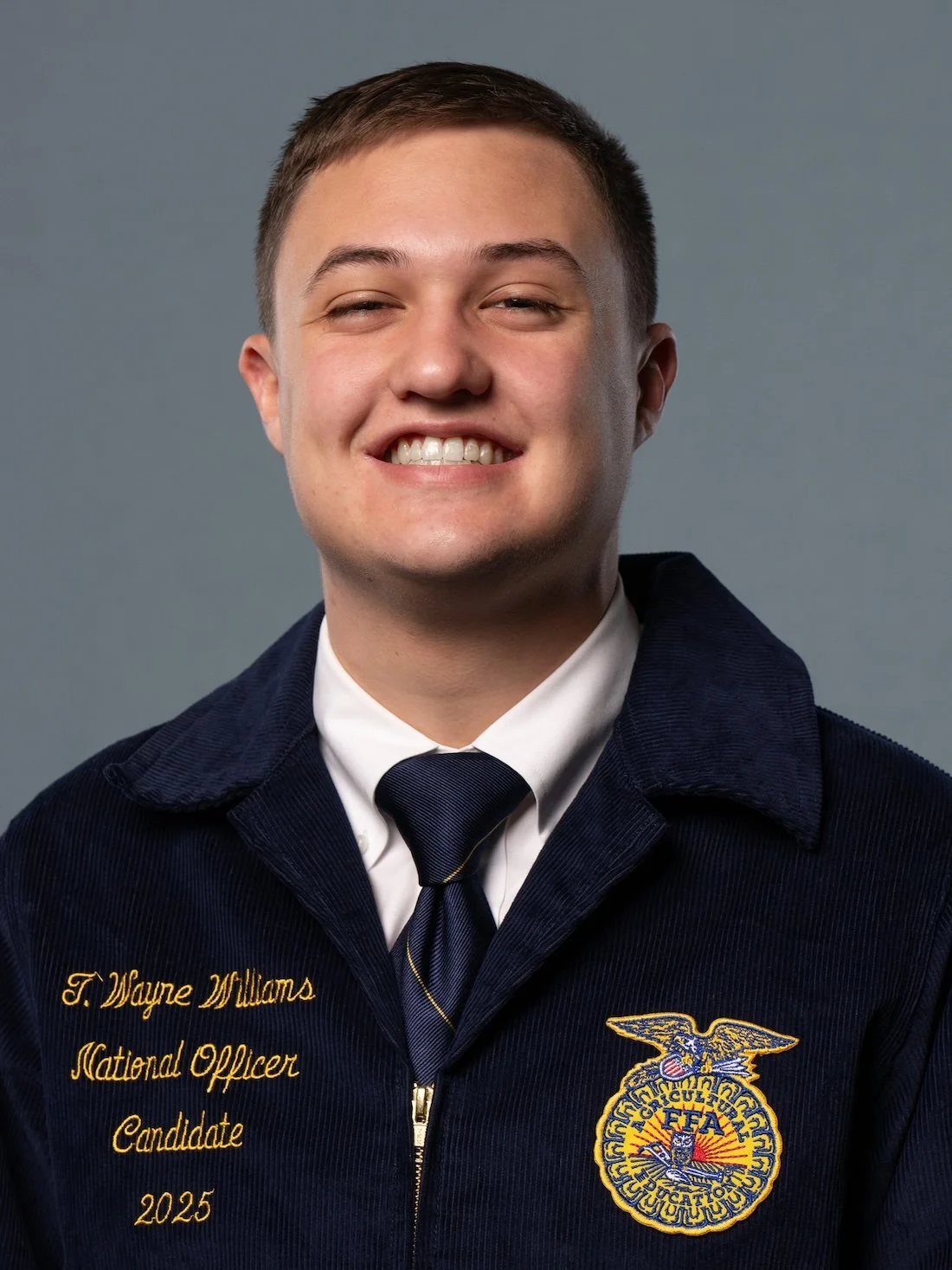
Cannon County native T. Wayne Williams was elected Southern Region Vice President for the National FFA Organization during the 98th National FFA Convention & Expo held Oct. 29–Nov. 1, 2025, in Indianapolis, Indiana.
As part of National FFA Week, Tennessee Corn is proud to spotlight T. Wayne Williams, a Cannon County native studying agricultural communications at Tennessee Tech who is currently serving as a 2025-2026 National FFA Officer. In this national leadership role, T. Wayne represents FFA members from across the country, bringing with him the values, experiences, and perspective of growing up in rural Tennessee.
Tennessee Corn is a longtime supporter of FFA and is proud to invest farmer checkoff funds in programs that help cultivate the next generation of agricultural leaders. These efforts play a direct role in preparing students like T. Wayne to represent the future of agriculture.
We caught up with T. Wayne to hear more about what inspired his leadership path, what this new role means to him, and how he hopes to carry his FFA experience into a career in agriculture.
Q: What inspired you to pursue a leadership role with National FFA, and what does it mean to you to represent your Tennessee peers across the state?
T. Wayne:
What inspired me to pursue a leadership role with National FFA was a moment with an FFA member named Daltry during Fourth of July week at Camp Clements in Doyle, Tennessee, the oldest FFA camp in the nation. Daltry was a senior who had been involved in FFA for all four years, but on the first day of camp he told me, “T. Wayne, I don’t feel like I have a home in FFA, and I don’t see how five days at this camp will benefit me.”
In that moment, I leaned on the foundation my advisors, Emily Haley, Wesley Foster, and Trevor Higgins, had built in me. I told Daltry, “If you’ll take just one step out of your comfort zone, I promise you’ll grow this week, and I promise I’ll take that step with you.”
That week, Daltry played in every camp game, tried extemporaneous speaking and parliamentary procedure, and fully leaned in. At the end of camp, he told me, “That one step changed my life.”
That experience showed me the true heart of FFA: challenging others to grow and walking beside them as they do. Representing Tennessee as a National FFA Officer means carrying that responsibility, to be a voice, an encourager, and a bridge for members who are still searching for where they belong.
Q: What are your goals as a National FFA Officer?
T. Wayne:
My goal as a National FFA Officer is to live out a mission I call “Just One.” If, at the end of this year, I can look back and know that I made a meaningful difference in just one member’s life, then every mile traveled and every day served was worth it.
But “Just One” is more than a number, it’s a mindset. It means intentionally showing up for members who may feel overlooked, uncertain, or unsure of where they fit in FFA. It’s about creating spaces where students feel seen, heard, and valued, and helping them recognize their potential as leaders both inside and outside of agriculture.
Through chapter visits, leadership workshops, and one-on-one conversations, my goal is to encourage members to take that next step—whether that’s trying something new, finding their voice, or believing they belong. If I can help even one student discover confidence, purpose, or a sense of home in FFA, then this year of service will have accomplished exactly what it was meant to do.
Q: Tennessee Corn is proud to support FFA through programs like the Agriscience Fair, Ham Breakfast, and Washington Leadership Conference. How have these opportunities impacted your growth as a leader?
T. Wayne:
These opportunities have had a tremendous impact on my growth as a leader. I participated in the Agriscience Fair all four years of high school, including earning recognition as a national finalist twice. Through that experience, I developed a deeper understanding of agricultural research, problem-solving, and how to clearly communicate complex ideas, skills that continue to shape how I lead and advocate for agriculture today.
I was also fortunate to participate in the Tennessee Ham Breakfast, an experience that strengthened my confidence and professionalism. I had the opportunity to serve as the emcee for the event, which pushed me to communicate effectively with industry leaders, policymakers, and supporters of agricultural education. During that event, I also had the chance to meet the guest speaker, Trace Adkins, a proud FFA alumni and supporter, which reinforced the lasting impact FFA has on individuals long after they leave the blue jacket behind.
Each of these experiences, made possible through the support of organizations like Tennessee Corn, helped prepare me to lead with confidence, connect with others, and represent agriculture with pride at the state and national level.
Q: Looking ahead, how do you hope to use your FFA experience to shape your career in the agriculture industry?
T. Wayne:
Looking ahead, I hope to use the foundation FFA gave me to pursue a career in agricultural law and policy. Through FFA, I developed the skills to advocate effectively, communicate clearly, and understand the real-world challenges faced by farmers and ranchers. Those experiences sparked my passion for serving agriculture beyond the farm gate.
FFA showed me that policy decisions directly impact the livelihoods of producers and rural communities. My goal is to use my leadership experience, knowledge of agriculture, and commitment to service to help farmers and ranchers navigate complex legal and regulatory challenges, protect their operations, and ensure agriculture has a strong voice at the table.
No matter where my career leads, I plan to carry the values of FFA with me, integrity, service, and leadership, to support those who feed, fuel, and clothe our world and to help build a stronger future for the agriculture industry.
About the Tennessee Corn Promotion Board
The Tennessee Corn Promotion Board (TCPB) works on behalf of Tennessee’s corn farmers to invest checkoff dollars in research, market development, education, and promotion. Through these efforts, TCPB helps ensure a strong future for corn production across the state, while connecting the value of corn to consumers, livestock producers, and the industries that rely on it.