
Growing More Than Corn: A Father and Son Find Success in East Tennessee
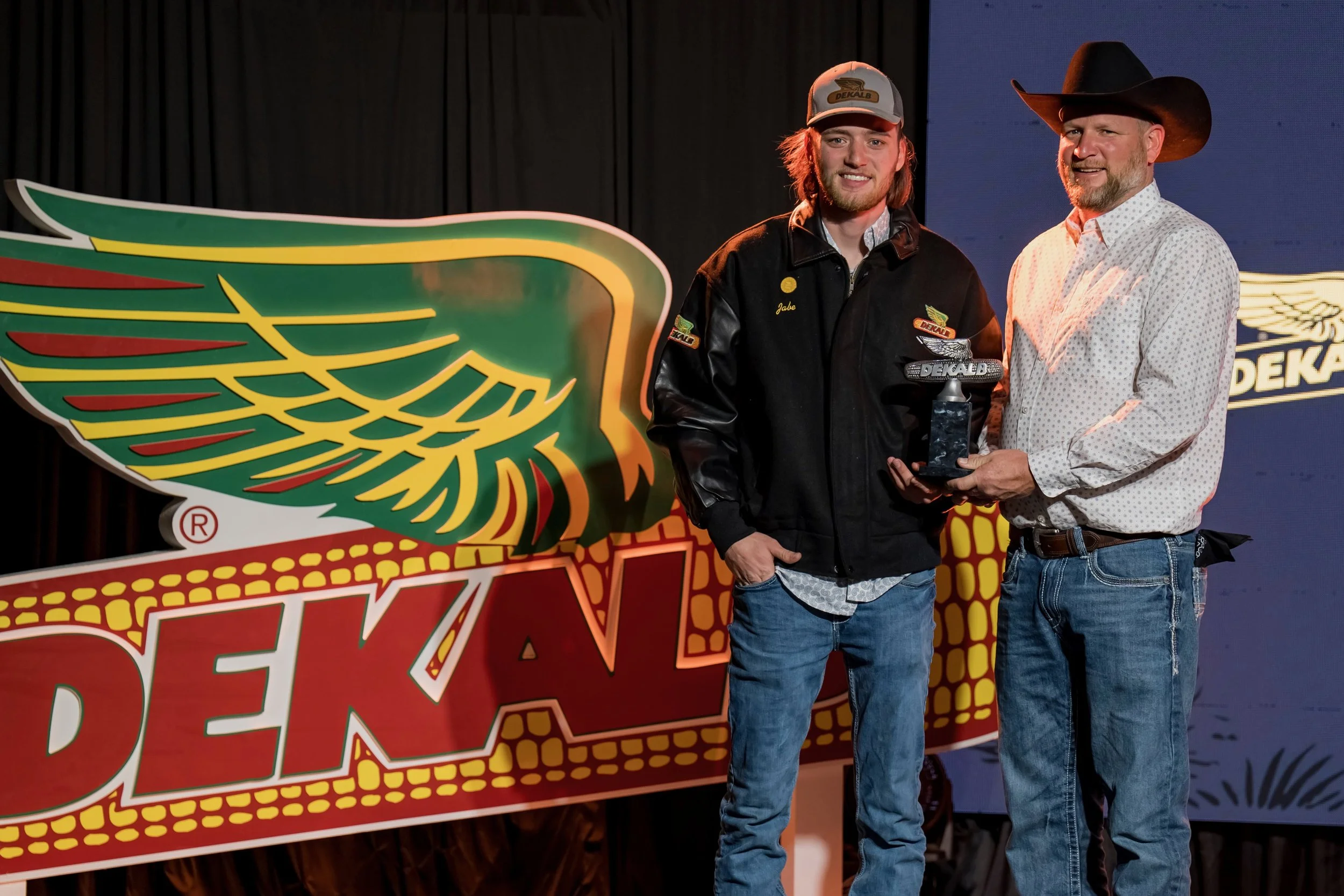
Jabe Watson, National Corn Yield Contest winner, accepting award from Dekalb.
For Josh and Jabe Watson, farming has always been about more than just growing a crop. It’s about the work ethic, responsibility, and value of carrying on a family tradition.
Josh is a fourth-generation farmer from Sweetwater, Tennessee, where his family has farmed since the 1890s. For decades, the farm primarily operated as a dairy farm. When their milk contract ended in 2018, Josh shifted his attention to row crops and expanded the corn, soybean, and wheat acres that were already in production.
Today, he farms alongside his son, Jabe, in the rolling fields of East Tennessee near the Smoky Mountains. With red limestone soils and elevations ranging from about 900 to 1,200 feet, their farm may not look like the large, flat fields often associated with high-yielding corn, but the Watsons have learned how to make the most of it.
In the 2025 National Corn Growers Association National Corn Yield Contest, both Josh and Jabe earned first-place finishes in non-irrigated categories. Josh placed first in the Conventional Non-Irrigated category with 387.61 bushels per acre, while Jabe won Strip/Min/Mulch/Ridge-Till Non-Irrigated category with 349.05 bushels per acre.
For Father’s Day, Tennessee Corn talked with Josh and Jabe about farming together, what each has learned from the other, and what it meant to bring two national awards home to East Tennessee.
Q: Can you tell us about your farm, its history, and how you became involved in agriculture?
Josh:
I’m a fourth-generation farmer on the same farm. It has been in our family since the 1890s. It was primarily a dairy farm for many years, and we milked cows until 2018, when our contract ended.
We had always raised row crops, but after that, we shifted to row crops full-time. We now grow corn, soybeans, and wheat. I put my whole heart and mind into trying to make a go of it after the dairy, and it has gone rather well.
I went to diesel school after high school and worked for a Caterpillar dealership for about a year. Then my dad offered me a job on the farm. That was around 1998, and I have been farming full-time ever since. We also have a diesel repair business that my wife helps oversee, and we work on some farm equipment there, too.
When did farming become something you and Jabe began doing together as father and son?
Josh:
Jabe has been working on the farm full-time for about a year and a half. He went to college for a couple of years. He came back to the farm and has been a really big help.
It is basically the two of us. We have some part-time help, and my brother, Caleb, also helps when he can.
What do you remember teaching Jabe early on?
Josh:
I would say the first thing I tried to teach him was work ethic. I also wanted him to learn that if you take care of the land, the land will take care of you.
Work ethic is number one. If you do not have it, there is not going to be much of a path for you in farming. More than anything, I wanted to teach him the values that come with being a farmer.
Jabe, what is something your dad taught you that still sticks with you today?
Jabe:
He taught me how to work hard and to always give 110%.
You both earned first-place awards in the 2025 National Corn Yield Contest. What did it mean to accomplish that in the same year as father and son?
Jabe:
It meant a lot to me. It was a pretty cool thing and a blessing to be able to grow a crop that good. That is not promised every year.
Josh:
I never dreamed we would bring home two national first-place awards. I am proud that we were able to bring those awards home for East Tennessee.
We are not known for having as many crop acres as other parts of the state, and we may not always have perfect growing conditions. Being able to show what can be accomplished here means a lot to me.
What first made you want to enter the National Corn Yield Contest?
Jabe:
Dad entered the contest first. After he did it, I thought, “Why wouldn’t I do that?” I wanted to see what my field could do and prove what we could grow.
What keeps me coming back is trying to get a better number each year. It’s about improvement and seeing what we have.
People have said East Tennessee can’t grow big-bushel corn. What has pushed you to challenge that idea?
Josh:
East Tennessee is not known for having the crop acreage that other parts of the state do, and we may not always have perfect growing conditions. But we have a good corn basis, and we have shown that we can still grow a strong crop here.
We also use a product from a local cornstarch plant to grow corn, and then that corn goes back to the same plant. It creates a recycling effect, or a regenerative agriculture cycle, that I think is a good thing.
What have you learned through participating in the yield contest?
Jabe:
I’ve learned that you are not promised a good yield every year. A lot depends on the weather. But you always want to improve and keep trying to do better.
Years from now, the yield numbers will stand out, but what will be remembered most is the hard work we put into it.
“It’s not always easy, but there is nothing like farming with your dad,” Jabe said.
For Josh, the opportunity to farm alongside his son is a blessing.
“I’m thankful for the corn growers and what the association does,” Josh said. “I’m thankful to be a farmer and thankful that God allowed us to farm. Even with the challenges we deal with, I wouldn’t want to do anything else.”
Want more stories like this?
Get the latest Tennessee corn farmer features, updates and insights delivered to your inbox. Sign up for our newsletter to stay connected with what’s growing at Tennessee Corn.